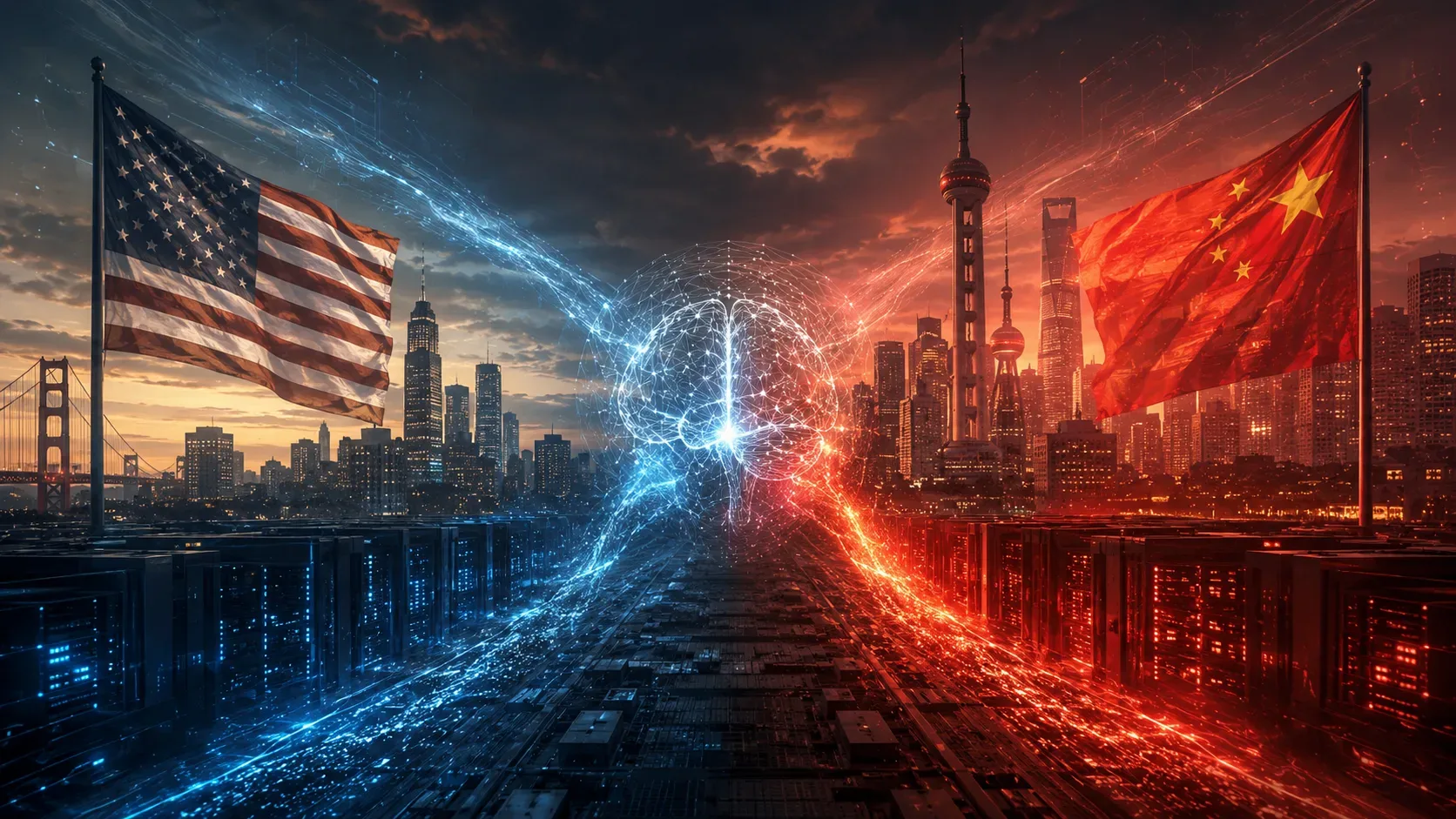
The new global race for artificial intelligence
The race for artificial intelligence is often compared to the space race of the 20th century. Just as the United States and the Soviet Union competed for technological supremacy in space, today the United States and China compete for leadership in the technology that many experts consider the basis of the next great industrial revolution.
The United States' early leadership was evident. Companies like OpenAI, Google, Meta, Anthropic and Microsoft have created some of the most advanced models in the world, driving an explosion of investment in generative AI starting in 2022.
The launch of ChatGPT in November 2022 made artificial intelligence a global phenomenon, reaching millions of users at an unprecedented pace and triggering a billion-dollar race for computing infrastructure, specialized chips and AI talent.
However, while American companies competed among themselves for leadership in increasingly larger and more sophisticated models, China began to pursue a different strategy.
Chinese strategy: less exclusivity, more scale
The main change in Chinese strategy was the understanding that winning a technological war does not always mean having the most advanced product.
In many markets, victory usually goes to those who can offer an efficient combination of quality, price and availability.
An often cited example is the Chinese automotive industry. Initially viewed with suspicion, it invested in large-scale production, efficient supply chains and more competitive prices. Chinese electric vehicle companies, such as BYD, have managed to gain ground internationally precisely by combining appropriate technology and more affordable costs.
In artificial intelligence, a similar logic has begun to emerge.
Instead of relying exclusively on the most expensive models on the planet, Chinese companies began to invest in more efficient models, capable of delivering results close to world leaders with less processing required and lower operating costs.
DeepSeek: the moment that changed market perception
The name that most symbolizes this change is DeepSeek.
In 2025, the company drew worldwide attention when it launched models such as the DeepSeek-V3 and DeepSeek-R1, demonstrating competitive performance in several assessments of reasoning, programming and problem solving.
One of the factors that drew the most attention was the cost. DeepSeek claimed to have trained its models using a much lower amount of computational resources than projects from American giants, although researchers point out that comparing costs between different laboratories requires caution due to differences in methodology, infrastructure and indirect investments.
Still, the impact was immediate.
The big message sent to the market was not that the United States had lost technological leadership, but that powerful models could be developed with more efficient approaches and significantly lower costs.
This shift altered investor perceptions and accelerated a new phase of global competition.
The claim that China has captured 61% of the market should be analyzed carefully
Many content on social media claims that China already has "61% of the AI market share in just 18 months". However, this statement needs contextualization.
The artificial intelligence market has different forms of measurement:
- number of models released;
- number of users;
- application downloads;
- corporate use;
- computational capacity;
- generated revenue;
- participation in open source models.
To date, there is no universal consensus among the main global consultancies that confirms that China controls 61% of the entire global AI market.
However, there is data that shows accelerated growth in the Chinese presence in some areas, mainly in open source models, domestic applications and adoption in its domestic market, which has more than one billion inhabitants.
Therefore, the most accurate scenario is not to claim that the war is over, but to recognize that China has significantly closed the gap to the United States.
The great Chinese difference: turning AI into a commodity
One of the most important theories in technological economics is that the biggest innovation does not always generate the biggest commercial winner.
Companies can dominate markets by making technology cheaper and more accessible.
China has important advantages in this model:
Industrial scale
The country has one of the largest industrial capacities on the planet, allowing it to produce hardware, electronics and technological infrastructure on a large scale.
Large domestic market
With hundreds of millions of digital users, Chinese companies can quickly test and adapt products.
Strong strategic support
The Chinese government considers artificial intelligence a strategic technology, investing in research, education, infrastructure and national development.
Intense competition among local businesses
Giants like Alibaba, Tencent, Baidu and new startups compete for space, accelerating innovation and price reduction.
The AI war could look like the war on smartphones and electric cars
There is an interesting historical pattern.
American companies often lead the creation of new technology categories, while Asian companies are in some cases able to transform these technologies into cheaper and more accessible products.
This has happened in several sectors of consumer electronics and is currently seen in the electric vehicle industry.
In AI, there is the possibility of something similar happening: extremely advanced models remain premium products, while cheaper and more efficient models become the dominant choice for most companies.
However, this outcome is not yet defined.
Silicon Valley still has huge advantages
To declare a definitive victory for China would be to ignore fundamental factors.
The United States still concentrates:
- the largest software companies in the world;
- top cloud infrastructure providers;
- some of the best research centers in artificial intelligence;
- large amounts of venture capital;
- leadership in advanced chips through companies like NVIDIA.
Additionally, American companies continue to launch extremely advanced frontier models and invest hundreds of billions of dollars in AI infrastructure.
The dispute is far from over.
What does this all mean for developers and technology professionals?
Perhaps the biggest lesson from this new phase of AI is that the competitive edge is changing.
For a long time, having access to the most advanced technology was a huge advantage.
Now, with models becoming increasingly cheaper and more accessible, the value tends to migrate towards the ability to apply artificial intelligence to solve real problems.
For developers, this means a change in mindset:
- learn how to integrate AI models into applications;
- understand prompt engineering and autonomous agents;
- master automations;
- combine business knowledge with technology;
- build specific products for niche markets.
Just as happened with the internet and smartphones, the greatest wealth will probably not only go to those who created the technology, but also to those who discover the best ways to use it.
Conclusion: the AI war is not over, but its rules have changed
The narrative that "China has already won the war on artificial intelligence" is provocative and attracts attention, but it simplifies an extremely complex dispute.
What is really happening is a major strategic shift.
The United States still leads the frontier in AI research, especially in the most advanced models and the infrastructure needed to train them.
On the other hand, China has demonstrated that it is capable of competing using a strategy based on efficiency, low cost, open source and large-scale adoption.
The big question of the next decade may not be who will create the smartest AI in the world, but who will be able to transform artificial intelligence into the most accessible, integrated and present tool in the lives of billions of people.
And this dispute is just beginning.